Add your promotional text...

Fair trading within the Pokémon TCG
Navigate the world of trading and purchasing Pokemon trading cards.
Ben R-E
3/5/20268 min read
The Pokémon Trading Card Game has experienced explosive growth in recent years, transforming from a beloved childhood hobby into a serious collecting and investment market. Whether you're a seasoned trader or just starting your Pokémon TCG journey, understanding how to properly value cards across different marketplaces is essential to maintaining trust in the community and protecting yourself from unfair deals.
For collectors, one of the biggest challenges is navigating price variations between different marketplaces. A card that sells for £40 on eBay might be listed for £30 on Cardmarket, and understanding these differences is crucial for fair trading. In this guide, we'll explore how to navigate these marketplaces, why prices vary, and how to ensure your trades are fair for everyone involved.
Understanding Market Value in the Pokémon TCG
Market value in the Pokémon TCG isn't a single fixed number, it's a range that fluctuates based on numerous factors. Unlike stocks with a single ticker price, Pokémon cards can have wildly different values depending on where and when you're looking. The market value represents what buyers are actually willing to pay and what sellers are willing to accept at any given moment.
Several key factors influence a card's market value. Rarity is perhaps the most obvious, with Special Illustration rares, Illustration rares, and vintage cards commanding premium prices. Condition is equally critical, a Near Mint card can be worth several times more than the same card in Played condition. Playability in the competitive scene creates demand spikes, while nostalgia drives collectors to pay premiums for cards from their favourite sets or featuring fan favourite Pokémon.
Finally, grading by companies like PSA or ACE can dramatically increase a card's value, particularly for high-grade vintage cards.
The Two Major Marketplaces: eBay vs. Cardmarket
eBay: The Familiar Marketplace
eBay remains one of the most popular platforms for Pokémon collectors, offering both domestic and international listings. Its familiarity and buyer protection schemes make it a comfortable choice for many traders. eBay's auction format can work in your favour, sometimes you'll find bargains below market value, whilst other times bidding wars drive prices above typical retail.


However, eBay comes with some downsides for sellers. Seller fees are substantial, often 12-13% after PayPal or payment processing fees, which sellers typically factor into their pricing. That said, eBay's "sold listings" feature is invaluable, it shows what cards actually sold for, not just asking prices, giving you real market data.
Cardmarket: The Bulk Buyers Dream
Cardmarket is the dominant platform across Europe and has become increasingly popular with UK collectors. Built specifically for trading card games, it offers superior filtering options, detailed condition grading, and language specifications.
The platform's fee structure is much more favourable to sellers, typically around 5%, which often translates to better prices for buyers.
Cardmarket offers several advantages. Many European sellers ship to the UK, and whilst you may occasionally encounter customs charges on higher value parcels, the competitive pricing often still makes it worthwhile. The platform's trend graphs are excellent for tracking price movements over time, something eBay lacks.
Cardmarket also allows you to display prices in GBP, making it easy to compare directly with eBay UK prices without needing to manually convert currencies.
More on why Cardmarket is a bulk buyers dream in a separate blog.
How to Research Card Values for Fair Trading
Step 1: Check Multiple Sources
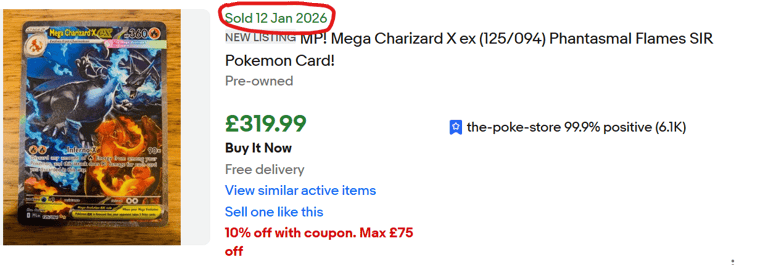
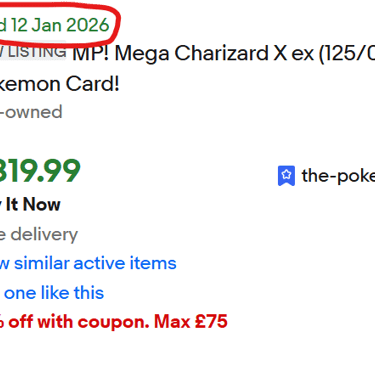
Never rely on a single listing or marketplace. Start by searching the exact card name, set, and card number on both eBay UK and Cardmarket. For eBay, use the "Filter" feature, select show more and tick "Sold Listings" to see actual sale prices, not just current listings.
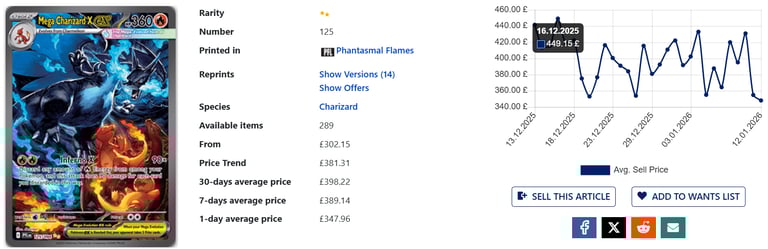
For Cardmarket, make sure you've set your currency preference to GBP in your account settings, then review the price trend graph and check the "from" price (lowest available) and the average price.
Step 2: Consider Condition Carefully
Condition grading can be subjective. One seller's "Near Mint" might be another's "Lightly Played." Always ask for additional photos if trading remotely.
On Cardmarket, sellers use a standardised condition scale (Mint, Near Mint, Excellent, Good, Light Played, Played, Poor), which helps create consistency.
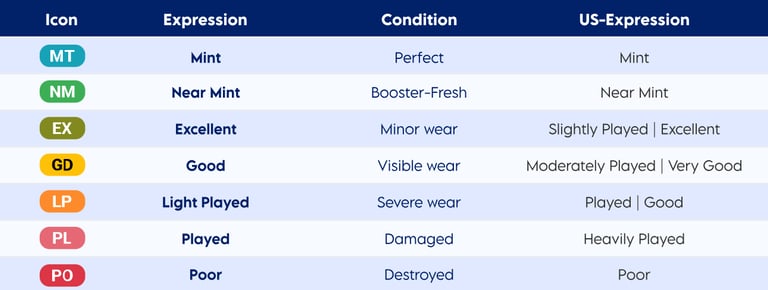
On eBay UK, condition descriptions are less standardised, so scrutinise photos carefully and don't hesitate to message sellers for clarification.
Step 3: Calculate True Cost
When comparing prices between platforms, always factor in the total cost. This means listing price plus shipping, plus any potential customs fees for EU purchases.
For eBay domestic purchases, you'll typically pay £1-3 for standard shipping. For Cardmarket EU sellers, shipping to the UK usually ranges from £2-6, but be aware that parcels valued over £135 may incur customs charges. A card listed at £30 with £3 shipping might actually cost you £33 total, whilst the same card at £28 on eBay UK with £2 shipping comes to £30, making eBay the better deal in this case.
Step 4: Look at Recent Sales, Not Old Listings
The Pokémon market moves quickly. A price from six months ago might be irrelevant today, especially for cards affected by tournament results, set rotations, or YouTube influencer hype.
On eBay, filter sold listings to show only the past 30 days. On Cardmarket, use the price trend feature to identify whether prices are rising, falling, or stable.
Step 5: Account for Language and Print Variations
Not all versions of the same card are equal in value. English-language cards typically command the highest prices in the UK market, as they're the standard for UK players and collectors. European language variants (French, German, Italian, Spanish) are often available on Cardmarket at lower prices, but they're generally less desirable for UK traders unless you specifically collect international versions.
Japanese cards are popular amongst collectors but less practical for competitive play in the UK. Always specify exactly which language and print version you're trading.
Creating Fair Trades
Fair trading isn't just about matching pound amounts, it's about ensuring both parties feel they're receiving equivalent value. Here's how to structure trades that work for everyone in the trading community.
Use the 10% Rule for Price Matching
Given the natural price variations between marketplaces, trades should be considered fair if they're within 10% of each other in total value. For example, if you're trading a card worth £40 for a card worth £38, that would be considered a fair trade even though there's a small difference. But remember, both parties need to be happy with this.
Share Your Pricing Research
When proposing a trade, share recent sold listings from eBay UK or Cardmarket price trends with your trading partner. This transparency builds trust and helps both parties understand the valuation. If you're factoring in potential customs charges, explain your reasoning.
Be Clear About Which Market You're Using
Before agreeing to a trade, both parties should align on which marketplace prices they're using as reference. You might agree to use eBay UK sold listings for all cards, Cardmarket averages for all cards, or a hybrid approach. Many traders prefer to use eBay UK as the primary reference since it reflects the domestic market.
Whatever you choose, make it explicit from the start.
Account for Market Position and Accessibility
Consider practical factors when valuing cards. If you're trading with another UK collector, eBay UK prices are the most relevant since they represent what you could easily sell for domestically. If trading with an EU collector, it might make sense to use a blend of eBay UK and Cardmarket prices. The "opportunity cost" approach ensures no one is losing value they could easily obtain by selling in their local market.
Address Imbalances Openly
If there's a value imbalance, don't ignore it. Options include adding cash to balance the trade (common in high-value trades), throwing in additional lower-value cards to equalise, or acknowledging the imbalance if both parties are comfortable (perhaps one person really needs a card).
Honesty about value discrepancies maintains trust in the trading community.
Common Pitfalls to Avoid
Even experienced traders can make mistakes that lead to unfair trades. Here are the most common issues to watch out for.
Cherry-Picking Favourable Prices - Don't use eBay prices for cards you're receiving and Cardmarket prices for cards you're giving away (or vice versa) unless there's a legitimate regional reason. This is one of the quickest ways to create resentment in trading relationships.
Ignoring Condition Differences- A Near Mint card is worth significantly more than a Lightly Played version. If you're comparing marketplace prices, make sure you're looking at the same condition grade. A common mistake is comparing your Near Mint card to an average that includes Played conditions.
Forgetting About Customs Risks: When valuing cards from Cardmarket, remember that higher-value parcels may incur 20% VAT plus handling fees when entering the UK. A £100 card might actually cost you £125-130 after customs, significantly affecting the value proposition.
Using Outlier Prices: One auction that ended at an unusually high price doesn't represent market value. Look at the median of recent sales, not the highest or lowest. Similarly, ignore clearly mispriced listings—a £100 card listed for £20 by mistake isn't market value.
Overlooking Shipping Costs: When comparing what you could sell a card for versus trading it, remember that selling on eBay incurs platform fees (12-13%), PayPal fees (2-3%), and Royal Mail postage (£1-3 for standard shipping). This means trading can be more valuable than the pure marketplace price suggests.
Final Thoughts: Building a Fair Trading Community
Fair trading isn't just about individual transactions, it's about maintaining the health and integrity of the Pokémon TCG community. Every unfair trade erodes trust and discourages people from participating in this hobby we all love. By taking the time to research prices across multiple marketplaces, being transparent about your valuation methods, and maintaining open communication with trading partners, you contribute to a positive trading environment.
Remember that the goal of trading isn't to "win" by getting more value than you give, it's to exchange cards in a way that makes both parties happy. Sometimes that means accepting a slightly lower value to get a card you really need for your deck or to complete a set.
The Pokemon TCG market will continue to evolve, with new platforms emerging and prices fluctuating based on countless factors. But the principles of fair trading remain constant: do your research, be transparent about marketplace differences and always treat your trading partners with honesty and integrity.
Whether you're trading a £5 common or a £500 vintage rare, these values should guide every transaction.
If you're in Peterborough, we host a monthly Trade event on the 2nd Monday of each month. We can aid in checking prices and ensuring trades are fair for both parties. For more information please join our Discord which can be found on the header bar.

Happy trading, and see you at the tables!